
Brilliant App Ideas for Startups & Entrepreneurs [2026]
Key Takeaways
- The strongest app ideas solve a specific, recurring problem rather than simply following a technology trend.
- AI, digital health, education, fintech, commerce, and vertical SaaS offer several promising opportunities in 2026.
- The billion-dollar startup ideas need a clear target audience, identifiable market gap, practical monetization model, and manageable MVP.
- Validation should happen before significant development investment through research, prototypes, interviews, and early user testing.
- Products such as Motion Academy, Al Muzaini, and Cobone show how focused ideas can evolve into real-world digital products.
The global app market is projected to reach $739.61 billion in 2026, with downloads expected to reach 528.48 billion worldwide. This growth continues to create opportunities for entrepreneurs looking for scalable digital products and new ways to solve evolving customer problems. For founders exploring Brilliant App Ideas for Start-Ups to Launch in 2026, the opportunity lies in identifying ideas that address real user needs and have clear potential for sustainable growth.
Finding the right startup app ideas, however, takes more than following the latest technology trend. The most promising concepts address a clear market gap, solve a recurring problem, and offer a business model that can support long-term growth. Some billion-dollar startup ideas may have the potential to attract significant investment, but strong execution and market validation ultimately determine their success.
From AI-powered solutions and personalized education to fintech, eCommerce, SaaS, and specialized consumer apps, there are plenty of app ideas likely to get funding in 2026. This guide explores promising opportunities, their market potential, monetization models, and MVP scope, while showing how mobile app product discovery can help validate your concept and reduce development risks before you invest heavily in building it.
What Makes an App Idea Worth Building?
A promising app idea usually sits at the intersection of user pain, market demand, differentiation, and monetization. Before investing in development, assess your concept against these questions:
| Factor | What to evaluate |
| Problem | Does the app solve a frequent or expensive problem? |
| Audience | Can you clearly define who will use it? |
| Demand | Is there evidence that people want the solution? |
| Competition | What existing products solve the problem, and where do they fall short? |
| Differentiation | What makes your product meaningfully better or more focused? |
| Monetization | Can the business generate revenue without damaging the user experience? |
| MVP scope | Can the core value be delivered without building everything at once? |
| Expansion | Does the concept have room to grow into additional features or markets? |
This framework is more useful than simply asking whether an idea is “unique.” A completely new category can require substantial user education, while an improved solution to a familiar problem may achieve traction faster.
Brilliant App Ideas for Startups to Launch in 2026
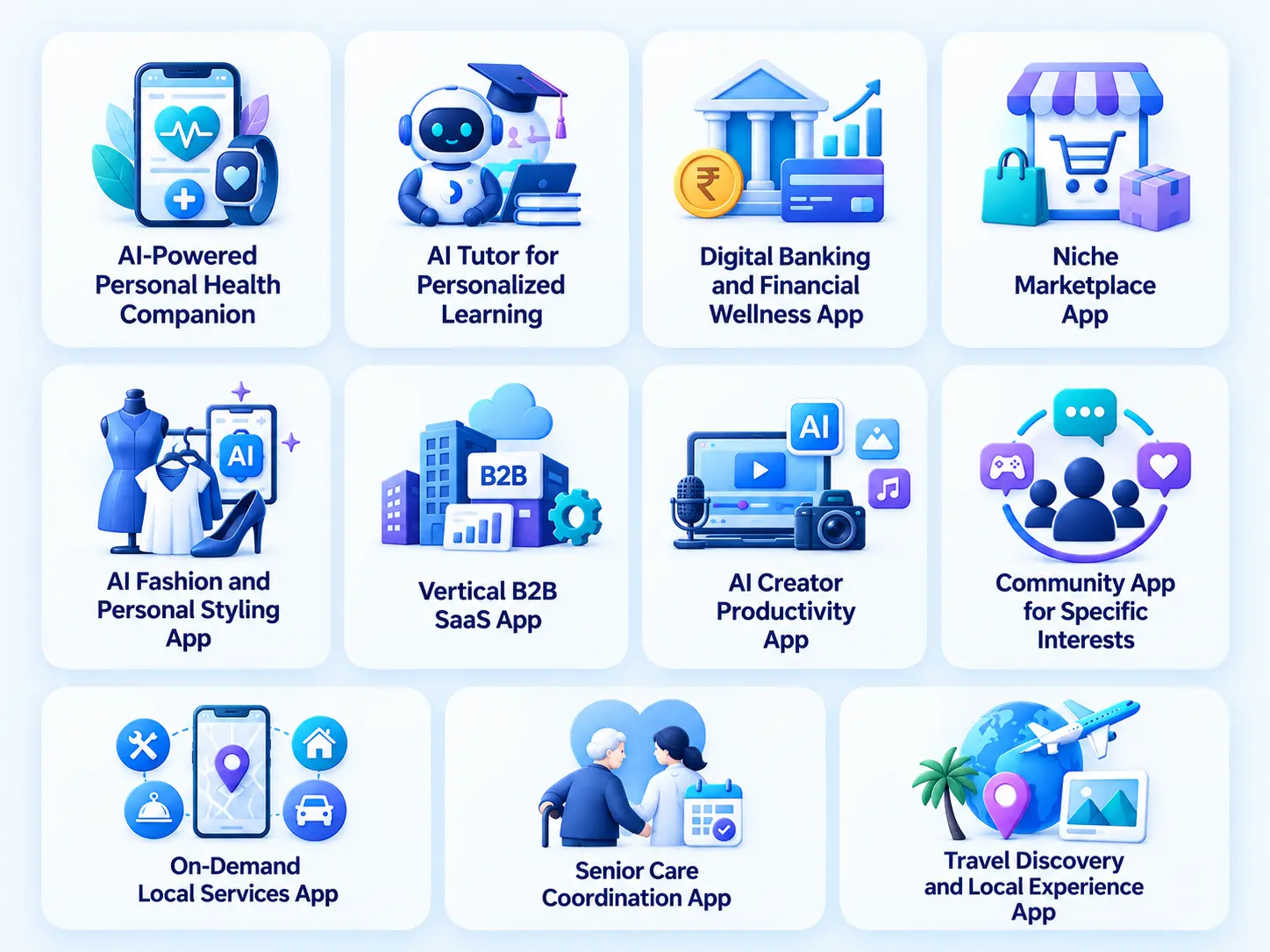
The following billion-dollar app ideas focus on markets where current signals indicate substantial commercial activity. Each idea also includes a practical market gap, monetization path, and MVP direction to help founders assess its real business potential.
AI-Powered Personal Health Companion
Problem: People often struggle to understand health information, organize personal wellness data, and determine what action to take next.
An AI health companion could bring personal health information, wellness tracking, educational content, reminders, and conversational guidance into one experience. The product should complement professional care rather than attempt to replace medical professionals.
Current market signal: According to Statista, the global digital health market is projected to reach $181.25 billion this year, with Digital Treatment & Care accounting for an estimated $95.05 billion.
Market gap: Many health apps focus on a single function such as fitness tracking, medication reminders, or consultations. A more useful product could connect multiple everyday health workflows while maintaining strong privacy and safety boundaries.
Monetization:
- Premium subscriptions
- Paid wellness programs
- Employer wellness packages
- Partnerships with healthcare organizations
- Optional paid expert consultations
MVP complexity: Medium to high. The first release could focus on conversational health education, personal tracking, reminders, and secure user profiles. Clinical workflows, integrations, and advanced AI features can follow after validation. Founders exploring this space can also review more healthcare app ideas for startups.
AI Tutor for Personalized Learning
Problem: Students often receive the same learning material despite having different knowledge levels, learning speeds, and areas of difficulty.
An AI tutor can personalize explanations, generate practice questions, identify weak areas, and create adaptive learning paths. The opportunity is particularly strong when the product focuses on a specific subject, exam, age group, or learning outcome rather than trying to serve every learner.
Current market signal: According to a Statista report, the global online education market is projected to reach $199.03 billion in 2026, while user penetration is expected to reach 12.2%.
Market gap: Generic AI tools can answer questions, but education products need a stronger learning structure. A specialized tutor can track progress and turn AI responses into a repeatable learning journey.
Monetization:
- Monthly or annual subscriptions
- Paid subject packages
- Premium test preparation
- Institutional licensing
- Family plans
MVP complexity: Medium. Start with one learner segment, one subject, AI-assisted explanations, practice generation, progress tracking, and basic personalization.
Real-World Proof: Motion Academy App Built by RipenApps
RipenApps built Motion Academy, an AI-powered education platform designed around personalized learning, adaptive study paths, and performance tracking. The platform has reached1M+ installs · 39.9K reviews, demonstrating the potential of focused EdTech products.
Digital Banking and Financial Wellness App
Problem: Consumers increasingly expect convenient ways to manage spending, payments, savings, transfers, and financial goals from a single digital experience.
A financial wellness app could combine budgeting, automated savings, personalized insights, bill management, financial education, and selected banking services.
Current market signal: The worldwide digital banking market is projected to generate approximately $1.66 trillion in net interest income in 2026. This figure refers specifically to net interest income, rather than overall digital banking market revenue.
Market gap: Many financial apps focus heavily on transactions. A stronger opportunity can come from helping users make better financial decisions before, during, and after transactions.
Monetization:
- Premium financial tools
- Subscription plans
- Referral or partner revenue
- Transaction fees
- Financial product partnerships
MVP complexity: High. Security, identity verification, financial integrations, compliance, fraud prevention, and transaction infrastructure can significantly increase development requirements.
Real-World Proof: Al Muzaini Built By RipenApps
RipenApps built Al Muzaini, a digital remittance and financial services app that has surpassed 100K+ downloads. The platform combines AI-powered KYC, biometric authentication, real-time exchange rates, and Western Union integration, demonstrating how a focused fintech idea can address complex financial workflows at scale.
Niche Marketplace App
Problem: Large marketplaces offer enormous selection but can make discovery difficult and provide limited specialization for specific communities.
A niche marketplace can focus on a defined category such as refurbished equipment, hobby products, professional supplies, local services, collectibles, or specialized consumer goods.
Current market signal: Global eCommerce revenue is projected to reach $3.86 trillion this year, with user penetration estimated at 57.1%.
Market gap: The opportunity is not necessarily another general marketplace. A focused platform can compete through better discovery, specialized seller tools, trusted communities, category expertise, or more relevant recommendations.
Monetization:
- Transaction commissions
- Seller subscriptions
- Featured listings
- Advertising
- Payment or fulfillment fees
MVP complexity: Medium to high. A first version needs buyer and seller profiles, product listings, search, payments, order management, messaging, reviews, and basic administration.
Real-World Proof: Cobone
RipenApps built Cobone, a digital commerce platform that has surpassed 500K+ downloads. The app combines location-based deal discovery, multi-currency payments, and access to offers across 20+ categories, demonstrating how a focused marketplace can scale into a high-usage digital product.
AI Fashion and Personal Styling App
Problem: Shoppers often spend considerable time deciding what to wear, what to buy, and how new products fit with their existing wardrobe.
An AI fashion app could analyze a user’s wardrobe, preferences, body measurements, occasion, weather, and budget to recommend outfits and products.
Current market opportunity: AI is becoming a broader software layer rather than a standalone category. The global generative AI market is projected to reach $394.66 billion this year, with a projected CAGR of 12.60% from 2026 to 2032.
Market gap: Generic recommendation engines are common. A stronger product could combine personalization with actual wardrobe context, shopping preferences, sustainability goals, and occasion-based recommendations.
Monetization:
- Affiliate commissions
- Premium styling subscriptions
- Brand partnerships
- Sponsored recommendations
- Virtual styling packages
MVP complexity: Medium. Start with wardrobe input, preference profiles, AI recommendations, outfit generation, and shopping links before adding advanced visual recognition.
Vertical B2B SaaS App
Problem: Businesses in specialized industries often rely on spreadsheets, email, messaging apps, and generic software that does not fit their workflows.
A vertical SaaS product can solve one industry’s specific operational problem, such as inventory management, field operations, compliance tracking, procurement, scheduling, or customer management.
Current market signal: The global Software as a Service market is projected to reach $488.53 billion this year, with an 11.86% CAGR projected from 2026 to 2031.
Market gap: Generic SaaS products compete across broad categories. Vertical products can differentiate through industry-specific workflows, terminology, integrations, reports, and automation.
Monetization:
- Per-user subscriptions
- Tiered business plans
- Usage-based pricing
- Enterprise contracts
- Paid integrations
MVP complexity: Medium to high. Begin with one workflow that customers currently manage manually. Add dashboards, permissions, integrations, and automation as adoption grows.
This model is particularly attractive for startup founders because recurring B2B revenue can provide a more predictable business model than advertising-dependent consumer apps.
AI Creator Productivity App
Problem: Creators spend significant time researching topics, writing scripts, editing content, repurposing posts, generating ideas, and managing publishing schedules.
An AI creator app could turn one piece of content into multiple formats, generate content briefs, create short-form variations, organize ideas, and maintain brand-specific style guidelines.
Current market signal: Generative AI is projected to generate $394.66 billion worldwide this year, highlighting the scale of investment and commercial activity around generative AI products.
Market gap: Generic AI writing tools are increasingly crowded. A focused creator product can differentiate by targeting a specific workflow, such as podcast production, video creators, newsletters, or social commerce.
Monetization:
- Freemium plans
- Creator subscriptions
- Usage-based AI credits
- Team plans
- Premium templates and workflows
MVP complexity: Medium. The initial product can focus on one high-value workflow rather than building a complete AI content studio. For more AI-focused opportunities, explore more AI app ideas.
Community App for Specific Interests
Problem: Broad social networks make it difficult for users to find smaller communities where conversations remain relevant and useful.
A community app could focus on a specific interest, profession, lifestyle, hobby, or shared goal. Features could include discussion groups, events, direct messaging, content sharing, expert sessions, and local meetups.
Market gap: The opportunity lies in depth rather than scale. A smaller but highly engaged community can create stronger retention than a broad platform where users encounter large volumes of irrelevant content.
Monetization:
- Premium memberships
- Paid communities
- Events
- Expert subscriptions
- Brand partnerships
MVP complexity: Medium. Build profiles, interest-based discovery, groups, messaging, moderation, and a simple activity feed first. For more social product opportunities, explore these social media app ideas.
On-Demand Local Services App
Problem: Finding trustworthy local professionals can still involve searching across multiple platforms, comparing availability, requesting quotes, and coordinating appointments.
An on-demand platform could connect users with verified providers for home maintenance, personal services, repairs, pet care, or other recurring local needs.
Market gap: The strongest opportunity is often not another general services marketplace. A focused platform can build trust around one service category through provider verification, transparent pricing, availability, reviews, and service guarantees.
Monetization:
- Commission per booking
- Provider subscriptions
- Lead-generation fees
- Featured listings
- Service fees
MVP complexity: Medium to high. A two-sided marketplace requires customer and provider experiences, scheduling, payments, location functionality, reviews, notifications, and administration. Understanding app development cost early can help founders set realistic MVP boundaries. For founders exploring this model, the on-demand app model can be expanded across multiple service categories after the initial marketplace proves demand.
Senior Care Coordination App
Problem: Families managing care for older relatives often need to coordinate appointments, medications, schedules, documents, caregivers, and communication. A senior care coordination app could provide shared calendars, medication reminders, care updates, appointment management, emergency information, and family communication.
Market gap: Many individual tools solve parts of the problem. A coordination layer that brings family members and caregivers into one secure workspace can create stronger practical value.
Monetization:
- Family subscriptions
- Caregiver plans
- Employer benefits
- Partnerships with care providers
- Premium coordination services
MVP complexity: Medium. Begin with shared care plans, reminders, appointments, secure communication, and role-based access.
Travel Discovery and Local Experience App
Problem: Travelers increasingly have access to huge amounts of information but still struggle to turn it into useful, personalized plans. A travel discovery app could combine local recommendations, itinerary building, interest-based discovery, community reviews, and personalized suggestions.
Market gap: Instead of competing with broad booking platforms, a startup can specialize in discovery before the transaction. For example, it could target solo travelers, families, food-focused travelers, outdoor enthusiasts, or weekend trips.
The app can generate revenue through affiliate commissions, booking commissions, premium itineraries, local business promotions, or subscription plans. For the MVP, start with destination discovery, personalized recommendations, saved places, itinerary planning, and community reviews before expanding into more advanced booking and personalization features.
App Ideas by Industry
Explore promising app opportunities across key industries, with each idea matched to a clear user need, market opportunity, and monetization potential.
| Industry | App idea | Primary monetization |
| Healthcare | AI health companion | Subscription + partnerships |
| Education | AI tutor | Subscription + licensing |
| Fintech | Digital banking & financial wellness | Fees + subscriptions |
| Commerce | Niche marketplace | Commission |
| Fashion | AI personal styling | Affiliate + subscription |
| B2B | Vertical SaaS | Recurring subscription |
| Creator Economy | AI creator productivity | Subscription |
| Social | Interest-based community | Membership |
| Services | On-demand local marketplace | Commission |
| Care | Senior care coordination | Subscription |
| Travel | Local discovery | Affiliate + bookings |
These categories should not be treated as guarantees. Market size alone does not create a successful product. The opportunity becomes stronger when the founder can identify a narrow customer segment, a painful problem, and a clear reason to switch from existing solutions.
How to Validate Your App Idea Before You Build
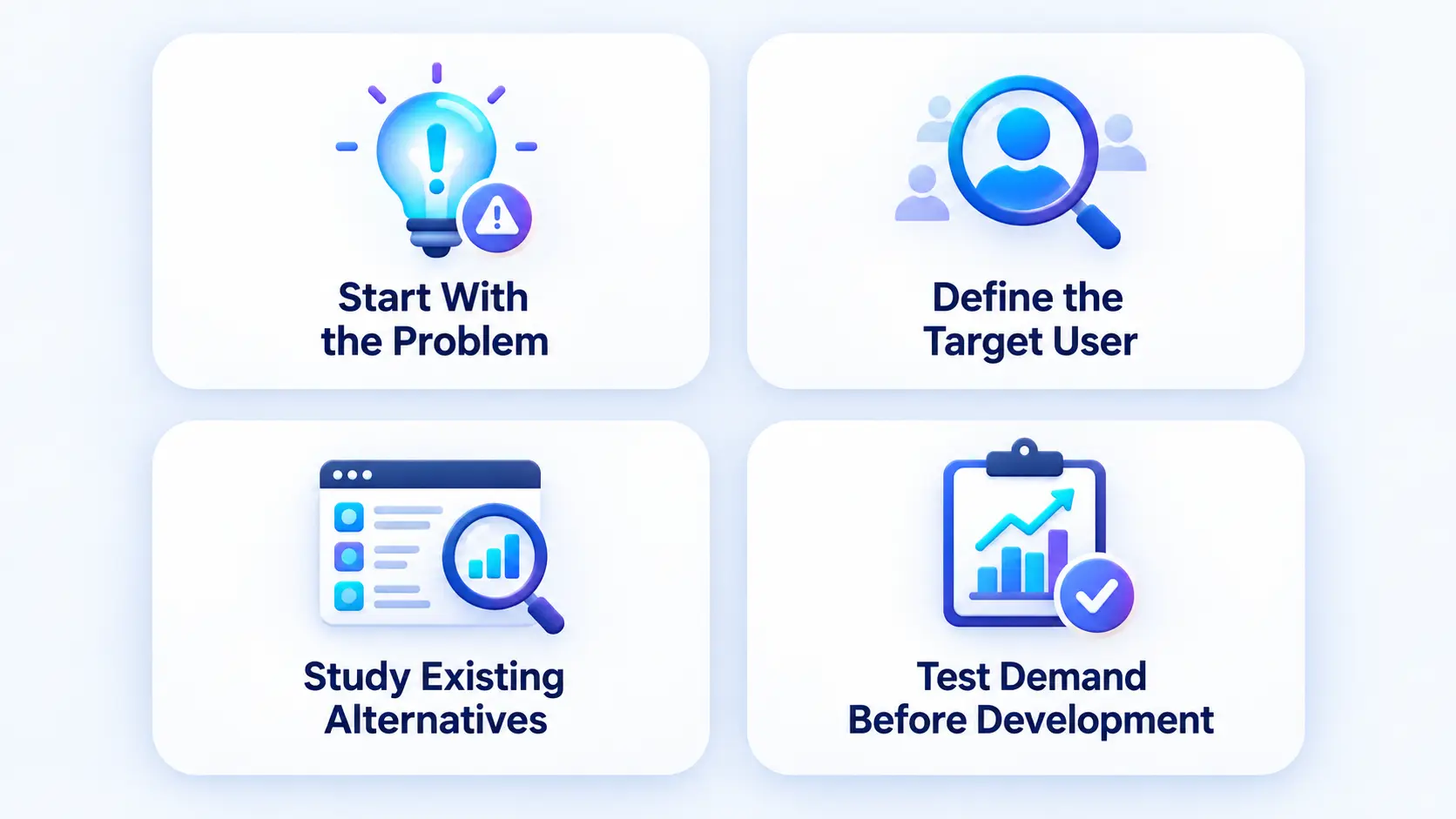
A promising concept should not immediately become a development project. Validation reduces the risk of spending heavily on a product that users do not need.
Start With the Problem
Start by defining the problem your app will solve in one clear sentence. For example, “Independent home-service providers lose bookings because customers cannot easily compare availability and prices.” This is more useful than simply saying, “I want to build an AI-powered service marketplace,” because the first statement focuses on a specific customer problem, while the second mainly describes the technology.
Define the Target User
Avoid targeting “everyone.” Define your first customer segment based on factors such as age or business size, location, profession, use case, frequency of the problem, current solution, and willingness to pay. A clearly defined audience makes it easier to understand user needs, prioritize features, and make informed product decisions.
Study Existing Alternatives
Your competitors are not limited to apps offering similar features. Users may already solve the problem through spreadsheets, WhatsApp groups, email workflows, local business directories, or manual processes.
Study how they currently handle the problem, what they dislike about existing solutions, what they pay, what remains unresolved, and what could convince them to switch. Often, the strongest opportunity lies in improving an existing behavior rather than creating an entirely new one.
Test Demand Before Development
Use interviews, landing pages, clickable prototypes, waitlists, surveys, and small paid campaigns to test the concept. Measure actions rather than compliments. Someone saying “That sounds useful” is weak validation.
Someone joining a waitlist, booking a demo, sharing contact information, or paying for early access is stronger evidence. Once the problem, audience, and value proposition are clearer, a structured product discovery process can turn the concept into a prioritized MVP.
How Much Should You Build in the MVP?
One of the most common mistakes with startup app ideas is trying to launch the complete vision in version one. Your MVP should answer one question:
What is the smallest product that can solve the core problem well enough for real users to adopt it?
For example, an AI tutor does not initially need every subject, advanced gamification, social features, live classes, and an extensive parent dashboard. A focused MVP might contain:
- Student profile
- One subject
- AI explanations
- Practice questions
- Progress tracking
- Basic personalization
After user feedback, the product can expand. The same principle applies to marketplaces, fintech products, SaaS platforms, and social apps. Development complexity increases with integrations, real-time functionality, AI processing, payments, security, multiple user roles, compliance requirements, and third-party systems. Before committing to a roadmap, estimate the likely development scope, timeline, technology requirements, and ongoing infrastructure costs. You can also explore more educational app ideas for additional opportunities in the EdTech space.
How RipenApps Turns Ideas Into Products
A strong app idea needs more than development execution. It needs a product strategy that connects the problem, user experience, technology, and commercial model.
RipenApps follows a structured product journey covering discovery, UX/UI design, development, quality assurance, launch, and ongoing product growth. Its current portfolio includes products across education, finance, commerce, healthcare, travel, and other categories. The three examples highlighted in this article show different paths:
- Motion Academy: demonstrates the potential of focused digital learning.
- Al Muzaini: demonstrates how a financial product can combine user convenience with complex workflows.
- Cobone: demonstrates the potential of specialized digital commerce.
These examples are useful not because they guarantee that a similar idea will succeed, but because they show how a product concept can be translated into a real application with defined users, workflows, and business objectives. For startup founders, the practical sequence is:
Problem – Validation – Product Strategy – MVP – Launch – Feedback – Scale
This approach prevents the product roadmap from becoming a collection of features without a clear business purpose.
Bottom Line
The best app ideas in 2026 are not necessarily the most futuristic. They are the ones that solve important problems and meet clear user demand, whether through AI-powered health tools, personalized education, digital banking, niche marketplaces, vertical SaaS, creator tools, specialized communities, or on-demand app services. But the idea itself is only the starting point.
The real competitive advantage comes from understanding the user, validating demand, defining a focused MVP, creating a sustainable monetization model, and continuously improving the product after launch. A billion-dollar outcome cannot be promised by an app concept. What founders can control is whether they build around a real problem, validate the opportunity early, and create a product capable of earning lasting customer trust.
FAQs
1. What are the best app ideas for startups in 2026?
The strongest opportunities include AI-powered health and education products, digital banking and financial wellness apps, niche marketplaces, vertical SaaS, creator productivity tools, specialized communities, and focused on-demand platforms. The best choice depends on the target audience, problem severity, competition, and monetization potential.
2. How do I know whether my app idea is worth building?
Start by validating the problem rather than the feature. Interview potential users, study competing solutions, test a landing page or prototype, and measure real behavior such as sign-ups, waitlist registrations, demos, or payments. Strong validation provides evidence that users care enough to act.
3. How can I make money from an app idea?
Common models include subscriptions, transaction commissions, advertising, paid features, marketplace fees, affiliate revenue, usage-based pricing, and B2B licensing. The right model depends on who receives the value and how frequently they use the product.
4. Are app ideas profitable in 2026?
They can be, but profitability depends on execution rather than the idea alone. Acquisition costs, retention, pricing, infrastructure, competition, product quality, and operational expenses all influence the outcome. A smaller app solving a high-value problem can be more commercially attractive than a large app with weak retention.
5. Do Companies Buy App Ideas?
Companies rarely buy an unvalidated app idea alone. They are more likely to acquire products with proven demand, users, revenue, intellectual property, or proprietary technology. Build and validate your idea first to make it more commercially valuable.
6. How Do I Patent or Protect an App Idea?
An idea alone generally cannot be patented. Depending on what you have created, you may protect the invention through a patent, software code through copyright, and the brand through a trademark. A U.S. provisional patent application can establish an early filing date and provides 12 months to file a corresponding nonprovisional application.