
Ditmara: A modular digital twin reference architecture
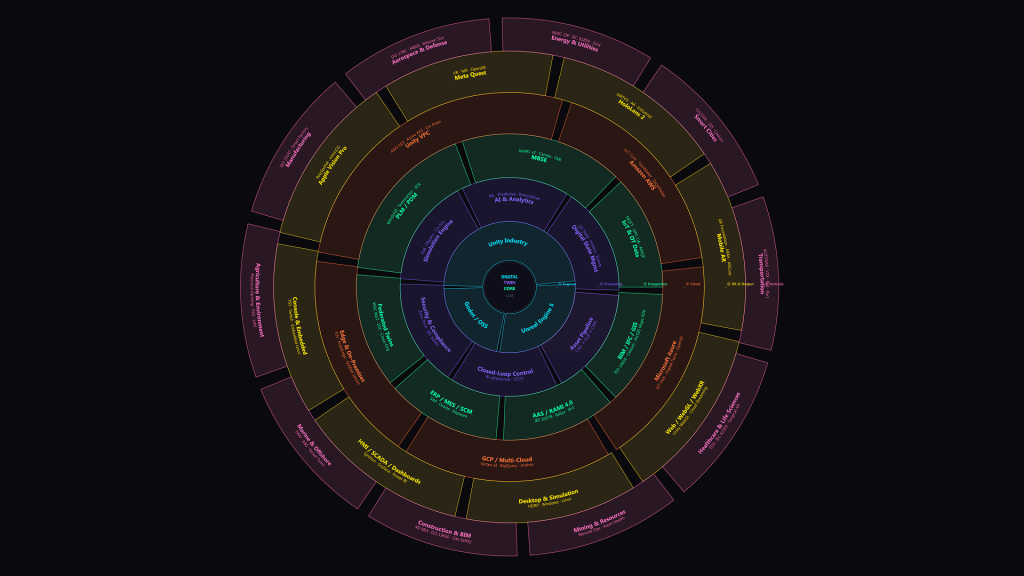
The six-layer architecture
Ditmara organizes digital twin concerns into six vertical layers. Data flows upward from the physical world to the services layer; closed-loop feedback flows back down. A parallel MBSE Integration Layer runs alongside, connecting formal systems engineering models to the operational twin.
Layer 1: Physical
The boundary between physical and digital. IoT sensors, PLCs, SCADA, LiDAR, GPS, edge devices, and industrial protocols (MQTT, OPC UA, Modbus, PROFINET) all live here. This is where reality enters the system.
Layer 2: Data ingestion
The normalization and translation layer. CAD/BIM imports, PLM/PDM connectors, time-series databases, stream processors, MBSE bridges, and GIS integration via Cesium (OGC 3D Tiles) or the ArcGIS Maps SDK for Unity/Unreal (for organizations operating within the Esri ecosystem). These are competing, not complementary, solutions. You choose based on where your geospatial data already lives.
Layer 3: Core processing
The real-time 3D engine. This is where Unity sits – rendering, simulating physics, running AI inference at runtime, and delivering immersive XR experiences. The framework is engine-swappable by design, but Unity’s High Precision Framework, Physics Engine, AI inference (Unity Inference Engine / ONNX), and XR capabilities make it a natural fit across the majority of digital twin use cases.
Layer 4: Services
Analytics, machine learning, operator training, and closed-loop command dispatch. This layer generates the actionable intelligence the twin exists to produce.
Layer 5: Cloud infrastructure
Hosting, DevOps, security, CI/CD. Runs on Azure, AWS, or on-premises. Manages version control and multi-platform distribution.
Layer 6: Model-Based Systems Engineering (MBSE) integration
The formal systems engineering bridge. SysML models define system architecture and requirements; the operational twin validates and refines those models through real-world data feedback. Every data artifact maintains full lineage from model to sensor to decision.